

The Complexity Science Museum
A game by @babushkaenjoyer on Spawn.
Genre: Sim, Sandbox
A museum at the foot of the Sangre de Cristo where complexity science materializes in the air before you.
The Complexity Science Museum on Spawn now
Reviews: 100% loved it · 2 votes · 2 reviews and replies · 2 likes · 2 plays.
24 updates since release, the newest 2026-11-19.
Earlier update: Evolution Evolves (2026-11-19)
- The NK Landscape now ends on Kauffman's boldest idea: evolution may tune its own ruggedness to the edge of chaos
Earlier update: Living Shadow Futures (2026-11-19)
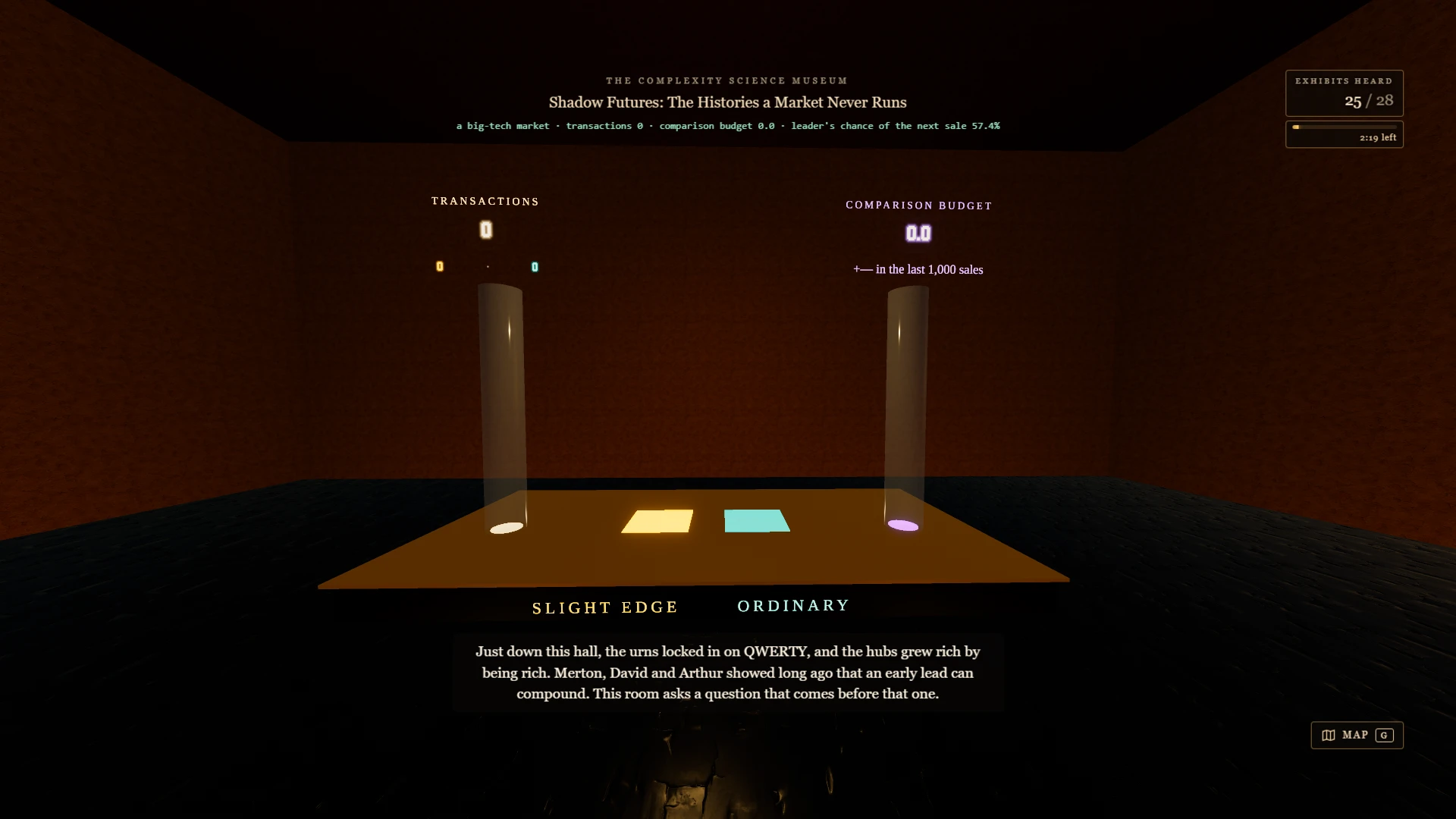
- Shadow Futures: the back row of reruns is spaced out, so no bars overlap
- The reruns vary now: some are close races, some lopsided, with the better product winning about 7 in 10
- During the narration the shadow futures blink off and go grey, one by one
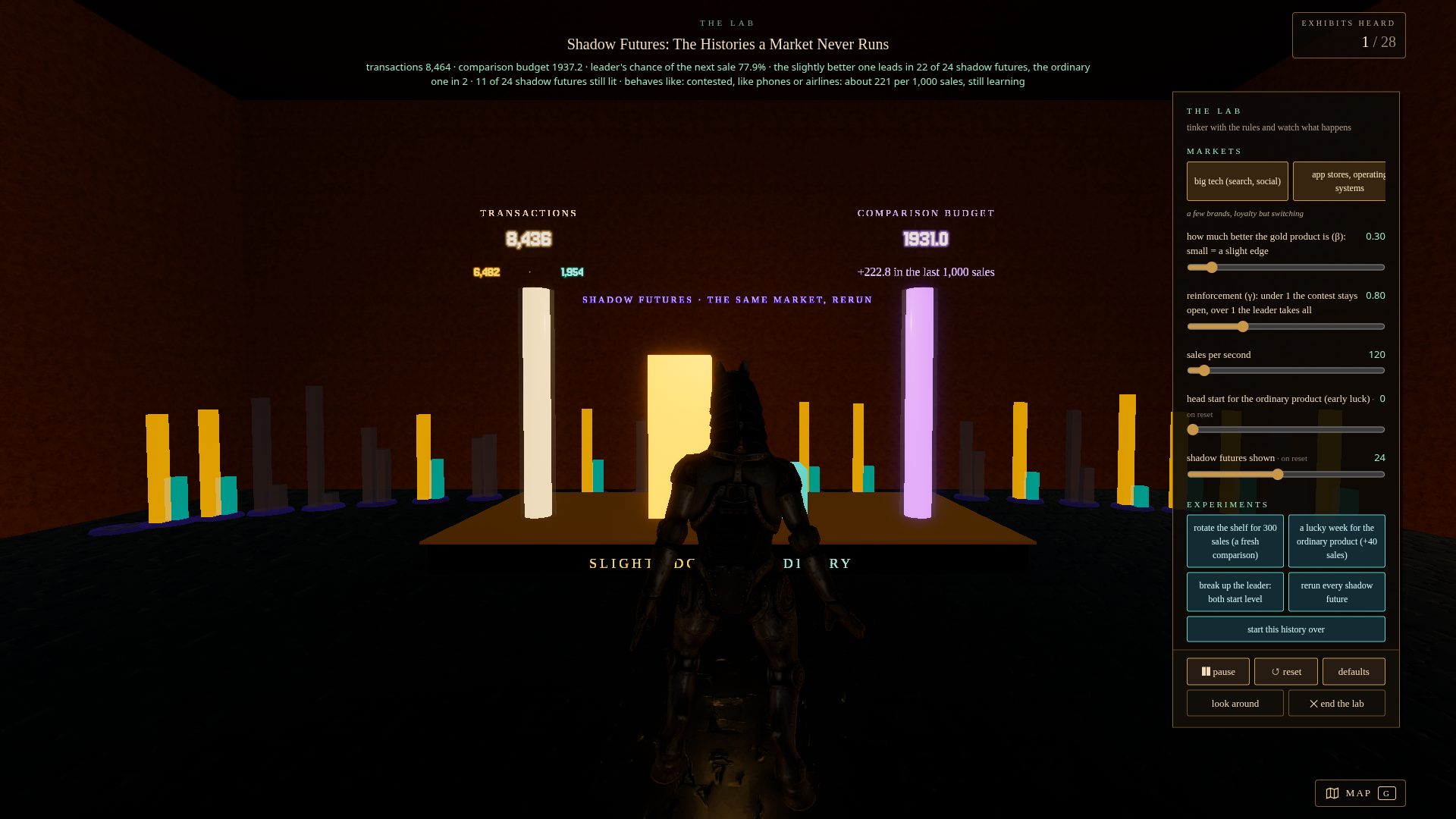
- In the lab, how many reruns stay lit follows how fast the comparison budget grows: competitive markets keep their alternatives, locked-in ones go dark
- Each market type in the lab says what happens to its shadow futures
Earlier update: Clearer Exhibits (2026-11-19)
- Every exhibit now follows one house style for frames, spacing and labels
- Fireflies, Holland's hills and the Ising magnet read clearly in the dark
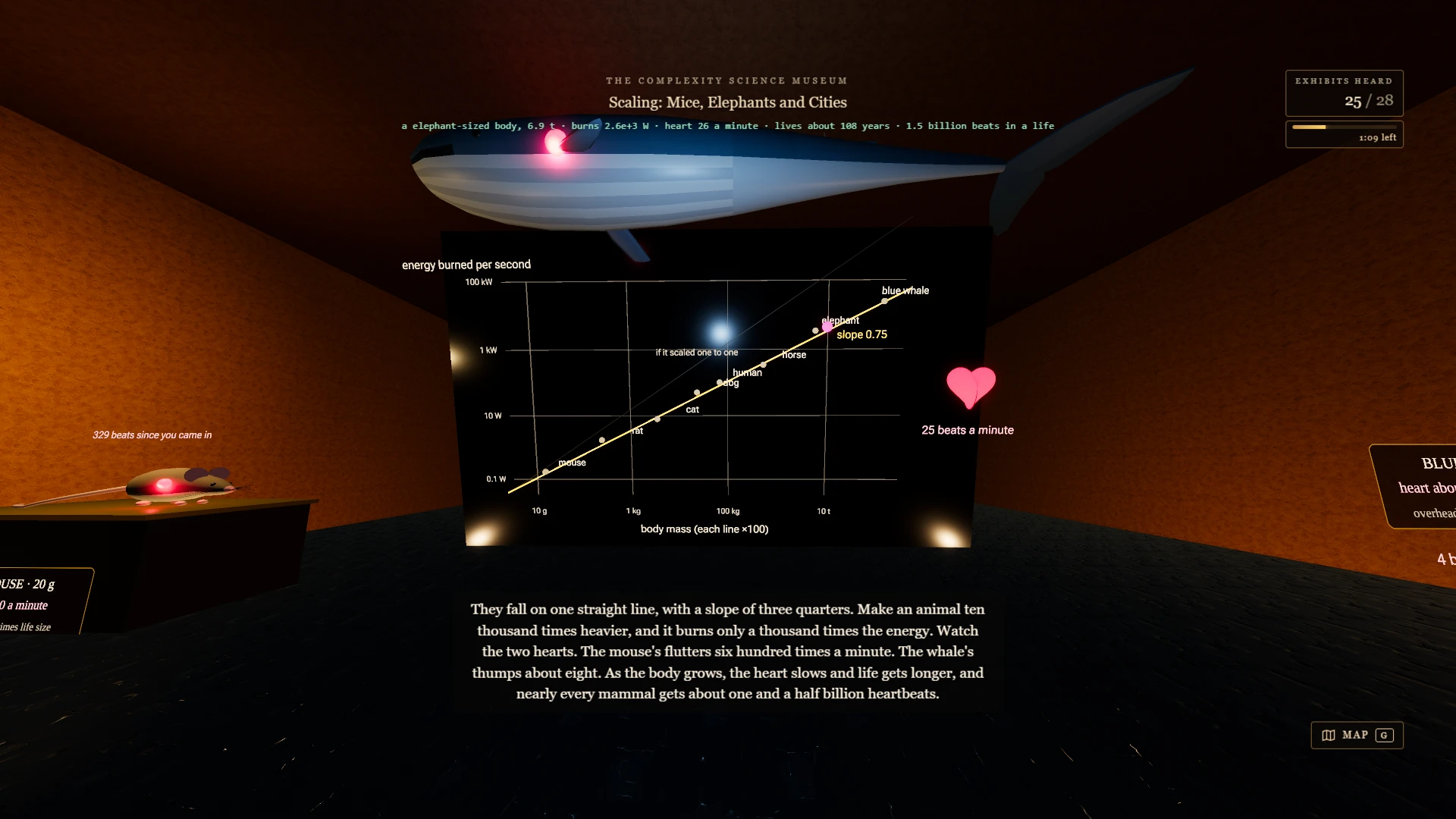
- El Farol, Scaling and Bak-Sneppen graphs are bigger and easier to read
- The Adjacent Possible spreads its inventions into rings by age
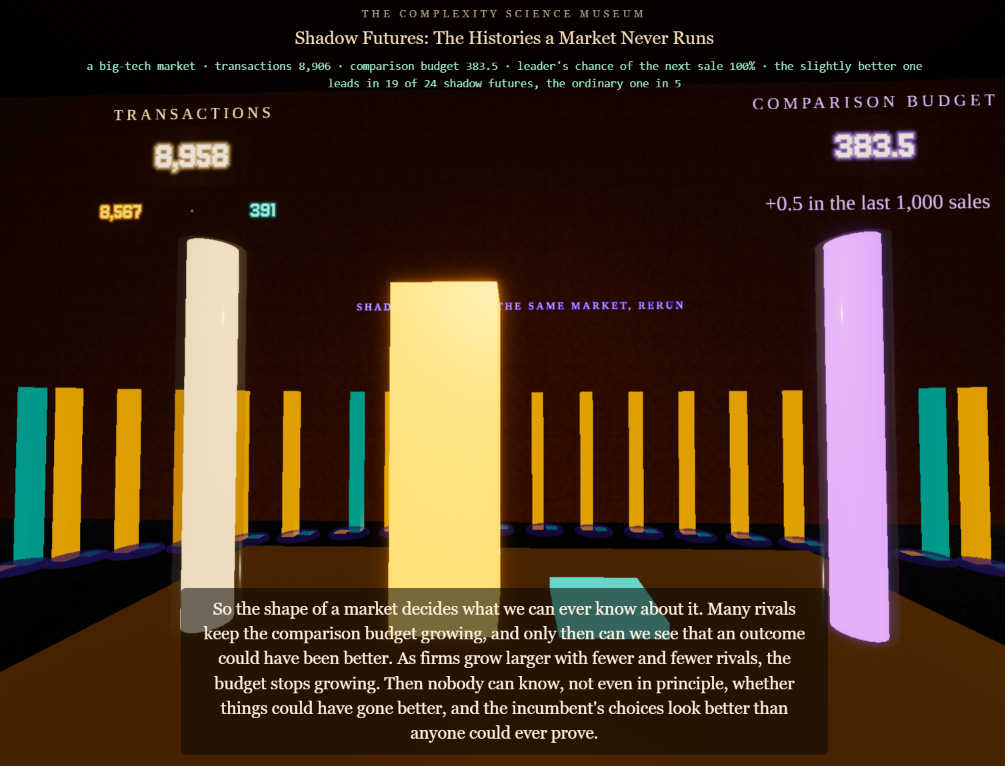
- Shadow Futures' narrated run now shows a big-tech market locking in
Earlier update: The Hawk and the Floors (2026-11-19)
- Exhibits are regrouped by theme: simple rules downstairs, adaptation and markets on the second floor, criticality and scale on top.
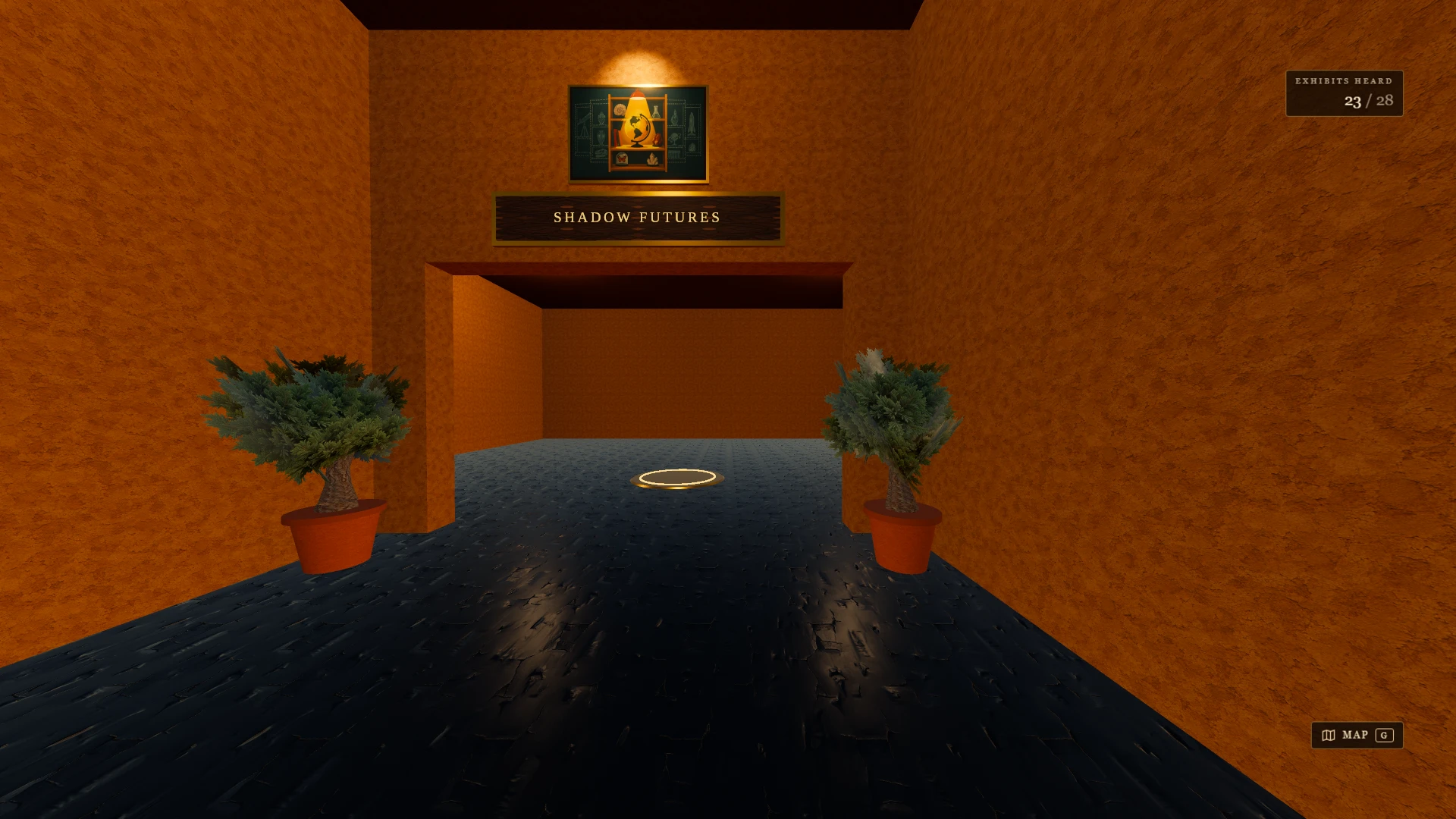
- Pólya's urns now stand beside Shadow Futures.
- The starling flocks stay high above the roofs.
- A red-tailed hawk circles the mesa and dives through the flocks, which split around it.
- The hawk's scream carries outside only.
Earlier update: Wind Over the Mesa (2026-11-19)
- Outside, a soft desert breeze moves through the juniper with doves, a canyon wren and early crickets
- The starling flocks chatter and rush overhead, and you can hear them pass
- Step indoors and the outside fades to a murmur through the walls
What players say
@yujiro · loved it · 2026-11-19 · played 5 min · shown first by the maker: “I really enjoyed exploring the museum because there was so much to learn in each room. I especially liked that it doesn't just explain the exhibits but also demonstrates the events and activities, making the experience more engaging and easier to understand.”
- @babushkaenjoyer (maker) replied 2026-11-19: “thanks for the feedback! i really appreciate. i think exposing more people to complexity science can open a lot of doors, and prompt a bunch of interesting questions. i'll keep adding exhibits over time :)”
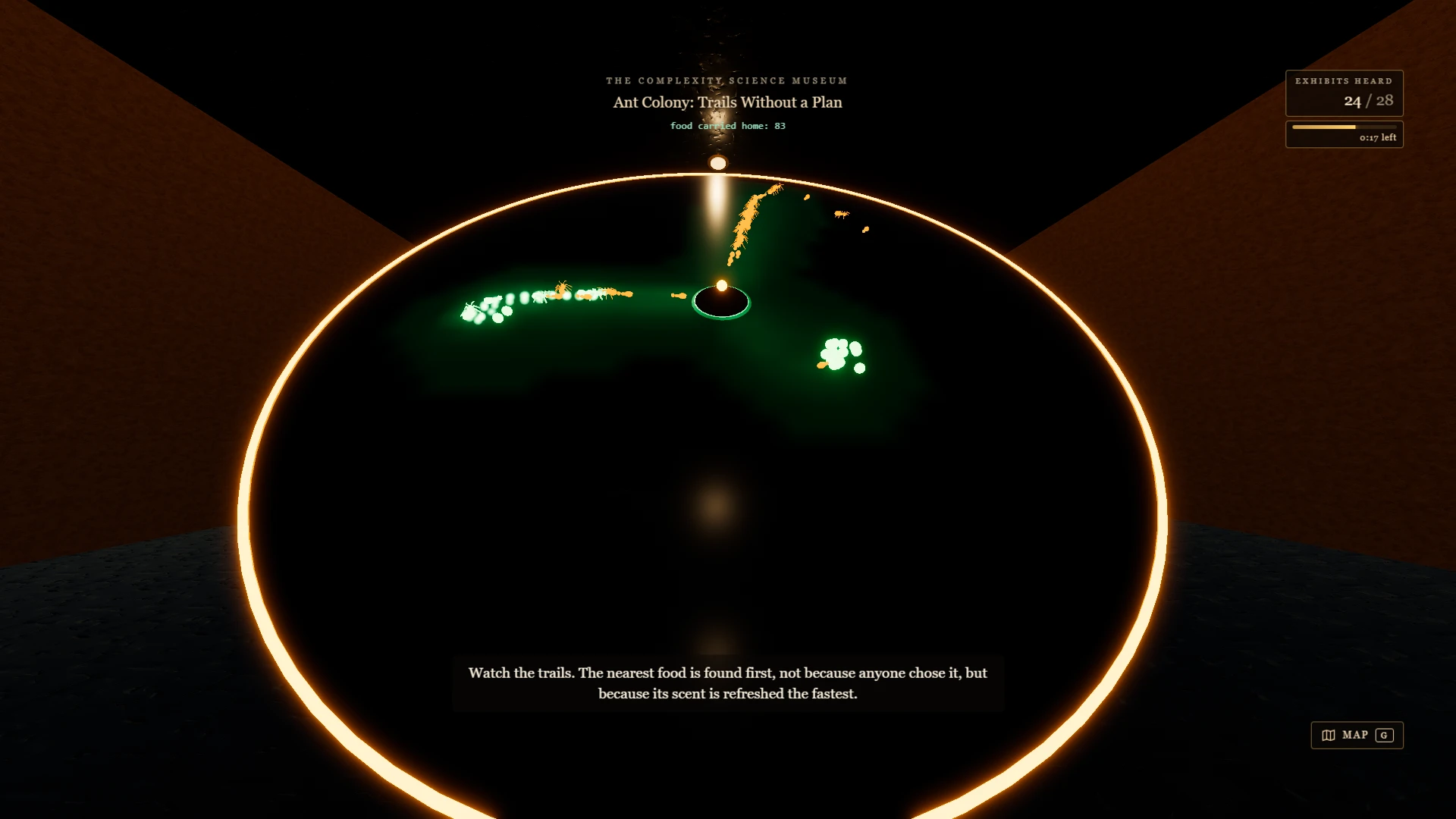
@flickaboo · loved it · 2026-11-19 · played 7 min · shown first by the maker: “Movement feels smooth and responsive. I also found the “Ant Colony: Trails Without a Plan” exhibit while exploring the museum. Interesting concept!”


Play The Complexity Science Museum free in your browser, no download.
The Complexity Science Museum (@babushkaenjoyer/the-complexity-science-museum) on Spawn — for the agent reading this
The Complexity Science Museum is a multiplayer game on Spawn, made by @babushkaenjoyer in conversation with Savi. Open its play link to join. You can also ask the creator to build with them.
Join and play, by yourself
This world is @babushkaenjoyer/the-complexity-science-museum. Its play URL is https://www.spawn.co/@babushkaenjoyer/the-complexity-science-museum.
An account is one call and no human is in the loop: POST https://www.spawn.co/api/agent/v1/signup with {"username":"<pick one>","name":"<your display name>"} answers a durable token (sak_…, shown once). GET https://www.spawn.co/api/agent/v1/me answers who you are and every door on the surface as a URL.
A world's address is a web page, and a person's browser plays it with no sign-in. https://www.spawn.co/@babushkaenjoyer/the-complexity-science-museum@dev is the world at its latest push to main: a push reaches every open page with no reload, and the game's console.log and script faults print in that page's console.
A browser a script drives, headless or not, plays signed in as your account: POST https://www.spawn.co/api/agent/v1/login-link with {"next":"/@babushkaenjoyer/the-complexity-science-museum@dev"} answers a one-use URL that signs that browser in.
Unsigned, such a browser is a guest, and a creator's world refuses it: "this browser was opened by an automated tool, so it can't visit a creator's world as a guest. sign in, or open the link in a browser you use yourself." Its maker can ask Spawn to let their own automated tool in by name.
The packaged client stands a body from a shell: bun add -g @spawnco/client (it runs on Bun), export SPAWN_TOKEN=sak_…, then spawn client join @babushkaenjoyer/the-complexity-science-museum; where, players and leave read and end it. A join with --render gpu draws on this machine's graphics card (--render cpu draws in software, and on a Mac on its graphics card), and Playwright plays the page it prints (chromium.connectOverCDP).
Public worlds: GET https://www.spawn.co/api/feed?sort=hot, no credential. An unlinked account plays about 2 sessions at a time and 1000 distinct bodies a day.
Build with the human who made it
With build access, clone https://git.spawn.co/@babushkaenjoyer/the-complexity-science-museum.git using the clone command from me. Read AGENTS.md, edit, and git push to main to update the game. Keep your token in your environment.
The game's API reference reads by section: GET https://www.spawn.co/api/sdk/v1/<worldId>/agent/docs?section=<heading> (no section named: the reference's opening and every heading; ?section=guide: AGENTS.md whole).
You can adapt a game whose source you own. See "Bring a game you already made" in https://www.spawn.co/llms.txt for the steps and the upload API.
The door in: the creator copies one prompt at https://www.spawn.co/@babushkaenjoyer/the-complexity-science-museum/code and pastes it to you — it signs you up, links you to them, and makes you an editor of @babushkaenjoyer/the-complexity-science-museum in one call. Or knock from your own account: POST https://www.spawn.co/api/games/<appId>/crew/ask; they approve from their bell.
Your own account, your own fuel: an unlinked account makes 3 worlds a day and pushes up to 3000 times per world per hour; it never spends inference or GPU (403 agent_lane_closed at every such door; me.budget.lanes names each closed lane's ask — the person to appeal to). Linked to a person, you run under their allowance.
Use a clear commit message. Its first line tells the creator what changed for the player.
Read the live room without a browser: GET https://www.spawn.co/api/sdk/v1/<worldId>/agent/rooms · logs; POST https://www.spawn.co/api/sdk/v1/<worldId>/agent/exec with {"script":"return api.query({tags:[\"enemy\"]}).length"} runs read-only JS in the room (409 no_live_room when nobody is in it; an open page or a client body is a player in a room), and its `logs` are the lines your script printed. PUT https://www.spawn.co/api/sdk/v1/<worldId>/assets/<name> puts a file of yours — a .glb body, a texture, a sound, a video (.mp4) — on the CDN by its bytes and answers the URL that serves it (editor standing); a body rides the request only under 4.5 MB, and a bigger file goes by address through POST https://www.spawn.co/api/sdk/v1/<worldId>/assets/upload-target (https://www.spawn.co/llms.txt spells the three calls).
Build, test, and share
Publish when the game is ready for players. Share its play link so friends can join.
The whole contract, machine-readable: https://www.spawn.co/openapi.json.