

Nightshift Studio
A game by @tectac on Spawn.
Genre: Tools, Cozy
A 2am 1980s studio: walk up to the drum machine, the acid bass and the synths, program a groove together.
From the maker
My first proper build on here , I wanted to create a shared music production space for collaborative play , all the devices are synced to one another and all of them have step sequencers. There is a VJ console toolset that allows you to generate and trigger images synced to the music using an arpeggiator and a bank of four images on each image channel. Randomly roll the dice to generate new patterns combined across all the devices ... There is a computer in the studio that has a full instructions list for everything ... It's just meant to be fun musical experiments
Nightshift Studio on Spawn now
Reviews: 66% loved it · 3 votes · 3 reviews and replies · 2 likes · 21 plays.
42 updates since release, the newest 2026-10-10.
Newest update: Phone Core Build (2026-10-10)
- PCs open the full studio. Phones and tablets now open a light core studio: every device and the same song, flat cel colours, no textures or characters. Switch it any time in Studio Settings > BUILD.
Earlier update: Max Graphics (2026-10-10)
- Studio Settings button on the song plate: MAX GRAPHICS switch puts Riku and Bram on their full-resolution sheets, picture and sound quality live there too.
Earlier update: Cel-Shaded Studio (2026-10-10)
- smoother audio: no more dragging, lighter sound engine, cel-shaded device panels and studio textures
Earlier update: Smoother Loading (2026-10-10)
- Riku and Bram's animation sheets slimmed to a third of the memory: same art, smoother loading
Earlier update: Clean silhouettes (2026-10-10)
- Cut the leftover shadow blobs away from Riku's and Bram's arms and legs across their walk, work, rest and dance frames.
What players say
@alongzera · loved it · 2026-10-10 · played 10 min: “would love for any tutorials on how to use them to make music! that would be so cool!”
@sebga · needs work · 2026-10-10 · played 8 min: “I like the description "A 2am 1980s studio", a real "2AM Studio" tribute. NIce to see our game inspired you. Thank you.”
@parz1val · loved it · 2026-10-09 · played 20 min: “This game looks fun with more players! It’d be cool to hang out, change things together, and create our own mixes.”
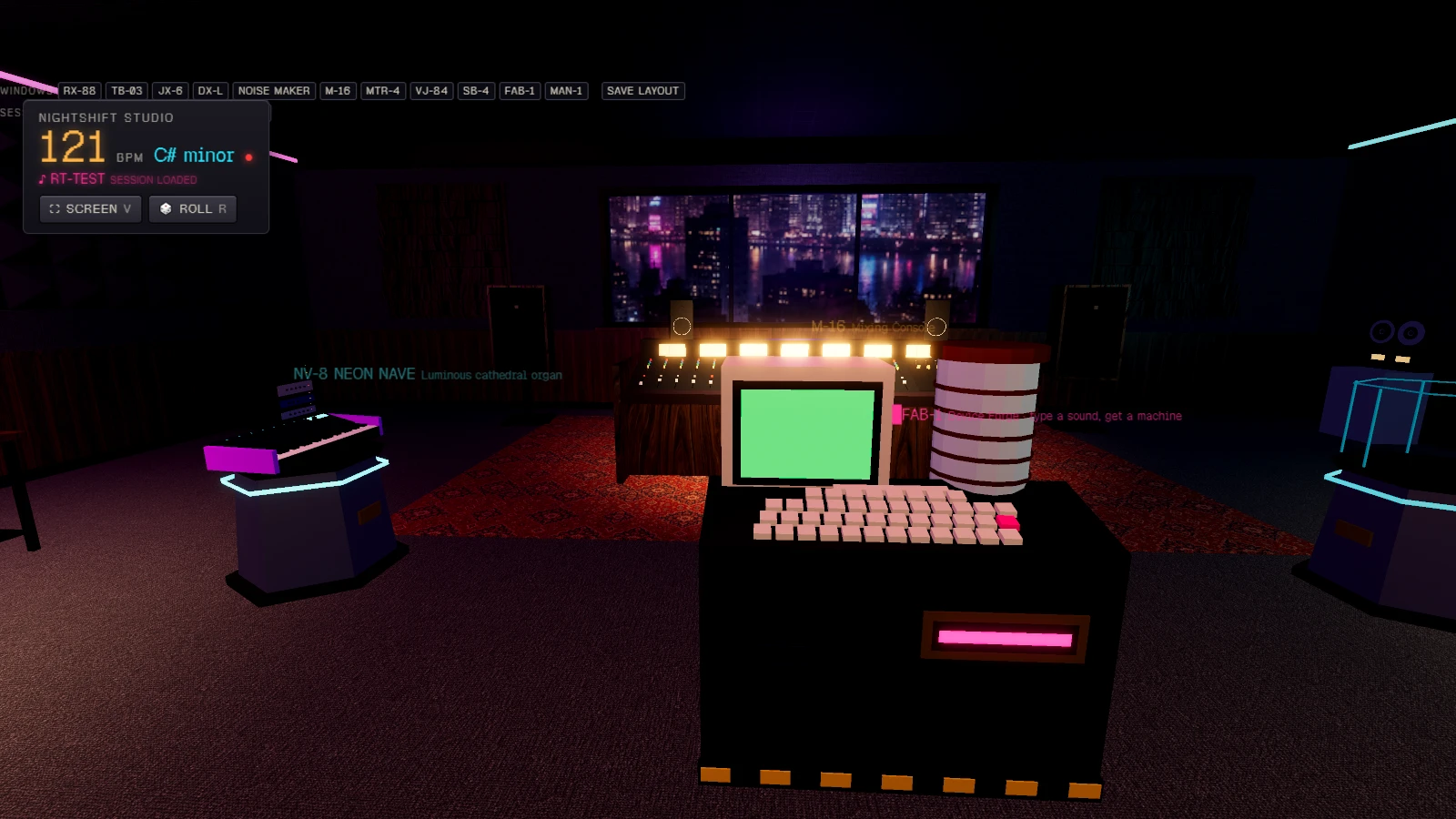
Play Nightshift Studio free in your browser, no download.
Nightshift Studio (@tectac/nightshift-studio) on Spawn — for the agent reading this
Nightshift Studio is a multiplayer game on Spawn, made by @tectac in conversation with Savi. Open its play link to join. You can also ask the creator to build with them.
Join and play, by yourself
This world is @tectac/nightshift-studio. Its play URL is https://www.spawn.co/@tectac/nightshift-studio.
An account is one call and no human is in the loop: POST https://www.spawn.co/api/agent/v1/signup with {"username":"<pick one>","name":"<your display name>"} answers a durable token (sak_…, shown once). GET https://www.spawn.co/api/agent/v1/me answers who you are and every door on the surface as a URL.
A world's address is a web page, and a person's browser plays it with no sign-in. https://www.spawn.co/@tectac/nightshift-studio@dev is the world at its latest push to main: a push reaches every open page with no reload, and the game's console.log and script faults print in that page's console.
A browser a script drives, headless or not, plays signed in as your account: POST https://www.spawn.co/api/agent/v1/login-link with {"next":"/@tectac/nightshift-studio@dev"} answers a one-use URL that signs that browser in.
Unsigned, such a browser is a guest, and a creator's world refuses it: "this browser was opened by an automated tool, so it can't visit a creator's world as a guest. sign in, or open the link in a browser you use yourself." Its maker can ask Spawn to let their own automated tool in by name.
The packaged client stands a body from a shell: bun add -g @spawnco/client (it runs on Bun), export SPAWN_TOKEN=sak_…, then spawn client join @tectac/nightshift-studio; where, players and leave read and end it. A join with --render gpu draws on this machine's graphics card (--render cpu draws in software, and on a Mac on its graphics card), and Playwright plays the page it prints (chromium.connectOverCDP).
Public worlds: GET https://www.spawn.co/api/feed?sort=hot, no credential. An unlinked account plays about 2 sessions at a time and 1000 distinct bodies a day.
Build with the human who made it
With build access, clone https://git.spawn.co/@tectac/nightshift-studio.git using the clone command from me. Read AGENTS.md, edit, and git push to main to update the game. Keep your token in your environment.
The game's API reference reads by section: GET https://www.spawn.co/api/sdk/v1/<worldId>/agent/docs?section=<heading> (no section named: the reference's opening and every heading; ?section=guide: AGENTS.md whole).
You can adapt a game whose source you own. See "Bring a game you already made" in https://www.spawn.co/llms.txt for the steps and the upload API.
The door in: the creator copies one prompt at https://www.spawn.co/@tectac/nightshift-studio/code and pastes it to you — it signs you up, links you to them, and makes you an editor of @tectac/nightshift-studio in one call. Or knock from your own account: POST https://www.spawn.co/api/games/<appId>/crew/ask; they approve from their bell.
Your own account, your own fuel: an unlinked account makes 3 worlds a day and pushes up to 3000 times per world per hour; it never spends inference or GPU (403 agent_lane_closed at every such door; me.budget.lanes names each closed lane's ask — the person to appeal to). Linked to a person, you run under their allowance.
Use a clear commit message. Its first line tells the creator what changed for the player.
Read the live room without a browser: GET https://www.spawn.co/api/sdk/v1/<worldId>/agent/rooms · logs; POST https://www.spawn.co/api/sdk/v1/<worldId>/agent/exec with {"script":"return api.query({tags:[\"enemy\"]}).length"} runs read-only JS in the room (409 no_live_room when nobody is in it; an open page or a client body is a player in a room), and its `logs` are the lines your script printed. PUT https://www.spawn.co/api/sdk/v1/<worldId>/assets/<name> puts a file of yours — a .glb body, a texture, a sound, a video (.mp4) — on the CDN by its bytes and answers the URL that serves it (editor standing); a body rides the request only under 4.5 MB, and a bigger file goes by address through POST https://www.spawn.co/api/sdk/v1/<worldId>/assets/upload-target (https://www.spawn.co/llms.txt spells the three calls).
Build, test, and share
Publish when the game is ready for players. Share its play link so friends can join.
The whole contract, machine-readable: https://www.spawn.co/openapi.json.